Where specialty coffee
is lived without rush,
among the coffee fields.
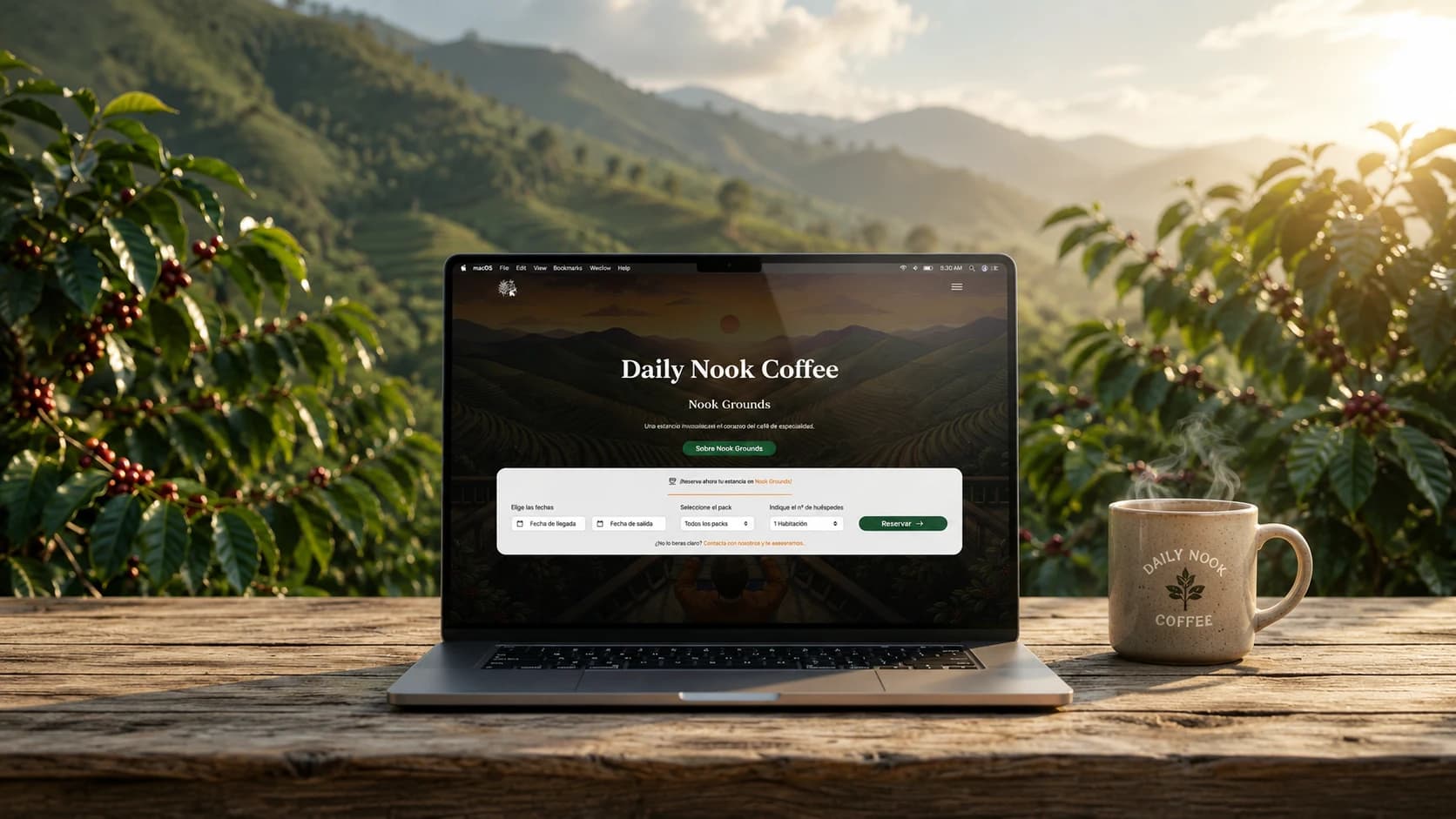
Daily Nook Coffee · The Nook Grounds — a resort for specialty coffee lovers set in the coffee estates of Colombia.
- Context
- Final project · UX/UI Course (La Hauss)
- Year
- 2026
- Role
- UX/UI · Research · Prototyping
- Tools
- Figma
I
The
Concept
“The challenge: turning a passion —specialty coffee— into a place to stay and live it.”
Daily Nook Coffee is my final project for the UX/UI Specialist Course at La Hauss. The brief: design the site for a resort meant to be lived in, with tiered stays, a simple booking process and a concept that's clear from the first scroll.
I chose to aim it at people for whom coffee doesn't taste like routine, but like ritual. That's how The Nook Grounds came about: a century-old Colombian coffee estate reinvented as a slow living sanctuary, built among the coffee fields, where guests don't just stay —they taste, learn and live specialty coffee from start to finish.
To meet the brief's requirements I designed the mandatory views —header and footer, home, the tiers category, the stay article and the booking checkout— and delivered them as a navigable prototype in its three versions: mobile, tablet and desktop, without forcing users to register in order to book.
II
The Research
Before designing a single screen, I spent time understanding who I was speaking to and what I was competing against. This phase defined two proto personas, a benchmark of three references and the site map that structures the whole navigation.
Proto personas
Sofía Cortés
Marketing Manager · 34 years old · Madrid
“I don't want coffee to wake up. I want coffee to stop.”
Profile
A perfectionist and an introvert. She values minimalist aesthetics, sustainability and quality over quantity. Her coffee is the only sacred moment of the day.
Goals
Escape urban noise and hyperconnection, feel cared for without being intruded upon, and enjoy coffee as a pleasure, not as fuel.
Frustrations
Massive, noisy hotels, strict breakfast schedules and forced tourist activities with crowds.
Mateo Gusto
Software engineer · 29 years old · Madrid
“I'm here to understand the science behind the magic.”
Profile
A methodical, self-taught coffee nerd. He perfects his pour-over on weekends and knows roasting theory, but has never set foot on a farm.
Goals
Validate his knowledge with practice: roast his own coffee, understand the process and talk to the people who grow the bean.
Frustrations
Superficial tourist tours, poorly extracted coffees that claim to be specialty, and the lack of transparency about the product's origin.
Benchmark
01
Finca Rosa Blanca
fincarosablanca.com
In favour
Minimalist, clean design with good use of space. Clearly identifies each tier and its price, uses breadcrumbs and filters, and shows a booking summary.
To avoid
The external booking engine breaks visual consistency, the breadcrumbs aren't clickable and the calendar doesn't make the status of each date clear.
02
Aquiares
aquiares.com
In favour
A hero that quickly communicates who they are and what they offer, a clean design and the booking status visible at all times. Lets you go back to the previous step.
To avoid
Redirects to an external page that breaks the flow, missing breadcrumbs, confusing button hierarchy and no room information.
03
Hacienda Venecia
haciendavenecia.com
In favour
A relevant CTA from the start, photos of the stay, modals with information and the main features shown visually.
To avoid
A very poor booking form with no booking engine, missing breadcrumbs, mixed languages and booking information that doesn't stay visible.
Site map
III
The Design
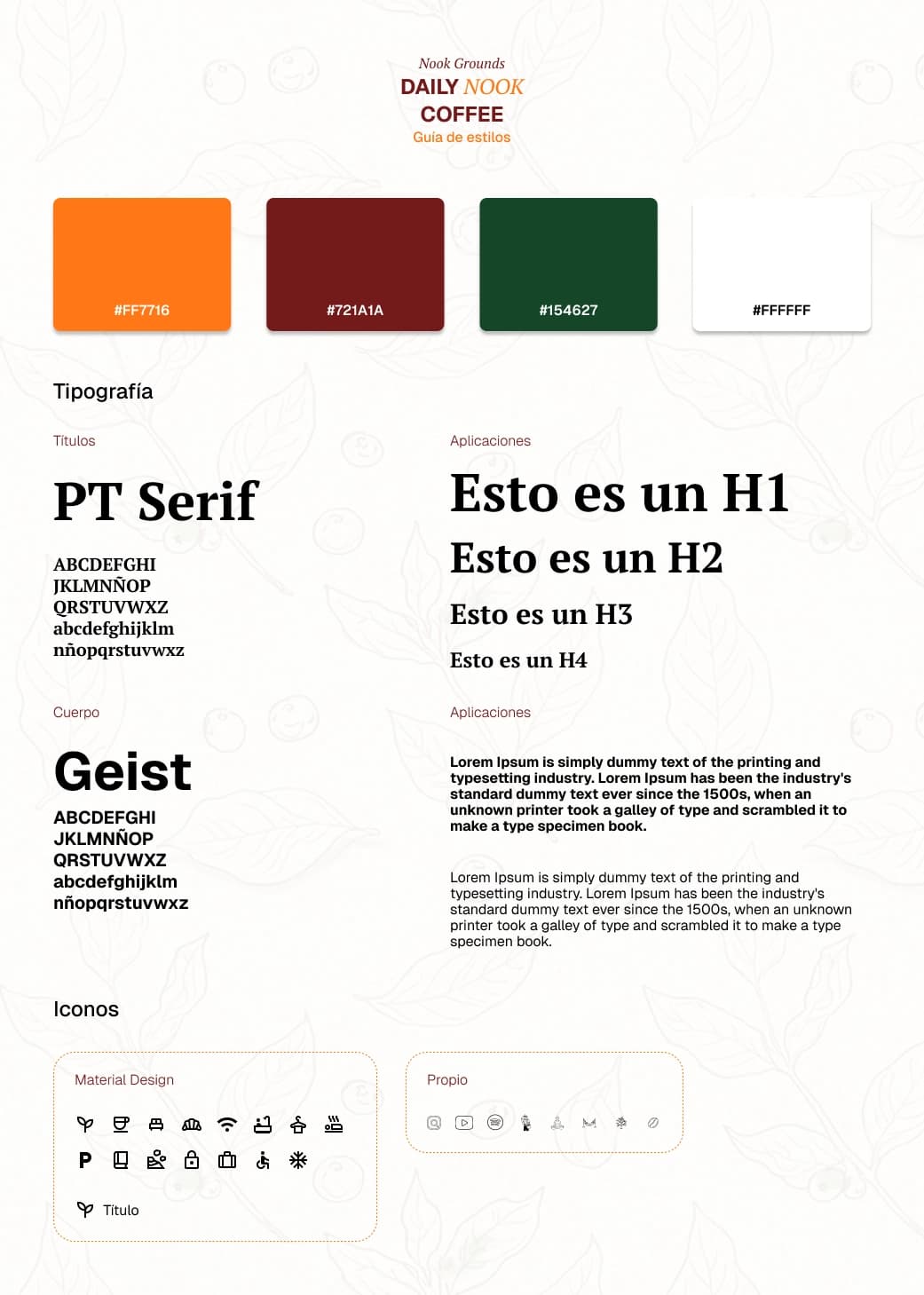
With the research clear, I built a visual system that breathes the coffee's origin: earth tones and coffee-field green, an editorial typeface with character and warm, handcrafted iconography.
The style guide brings together colour, typography and icons. From it I built a component library —navigation, cards, calendar, forms and the service icons— to keep everything consistent from the home to the checkout.
The tiers
Three packs that scale with how deep you go into the world of coffee —from absolute silence to mastering the craft—. Each level steps up the accommodation, barista equipment and experiences, and can be booked without registering.
Essential Pack
The Ritual of the Pause
The Garden Cabin
Absolute disconnection in an intimate adobe cabin: filter coffee you brew yourself (V60) and sensory rituals on your private porch.
from €329.99 / night
Premium Pack
The Alchemy of Origin
The Mill Loft
A sensory immersion in a historic loft in the old drying house: espresso machine, micro-lots and guided experiences such as the Origin Tour and the Sunset Cupping.
from €559.99 / night
Master Pack
The Master's Legacy
The Owner's House
Total mastery in a suite with fireplace and panoramic terrace: a La Marzocco GS3 machine, the rarest coffees and 100% private experiences, including roasting your own batch.
from €849.99 / night
The checkout
The booking is resolved in four steps, without forcing users to register and with breadcrumbs present at all times so they always know where they are and can go back. The goal: the fewest possible frictions between desire and booking.
01
Pack and dates
The user sees the selected pack and can change it, choose check-in and check-out dates and the number of guests.
02
Extras
Add additional services and experiences to personalise the stay before moving on to payment.
03
Payment
Enter the payment details to confirm the booking, with the order summary always in view.
04
Thank you page
A confirmation page closes the flow and recaps the booking with all its details.
Responsive prototype · mobile, tablet and desktop
IV
A prototype
for living coffee.
The result is a navigable Figma prototype in its three versions —mobile, tablet and desktop—, consistent from the home to the payment.
Beyond the screens, this project forced me to think like a product designer: start from real research, justify every decision with the site map and make sure the experience —like a good cup of coffee— is enjoyed without rush. It's the closing piece of the UX/UI Specialist Course at La Hauss and the one that best explains how I work.